
The 5% VAT in the UAE: Who Has to Register, and Who Doesn't
Most entrepreneurs setting up in the UAE spend their time researching corporate tax and treat VAT as a detail to handle later. Then they discover that VAT has been in force since 2018, that the registration deadline is measured in days rather than months, and that invoicing clients in Europe does not remove them from the system the way they assumed.
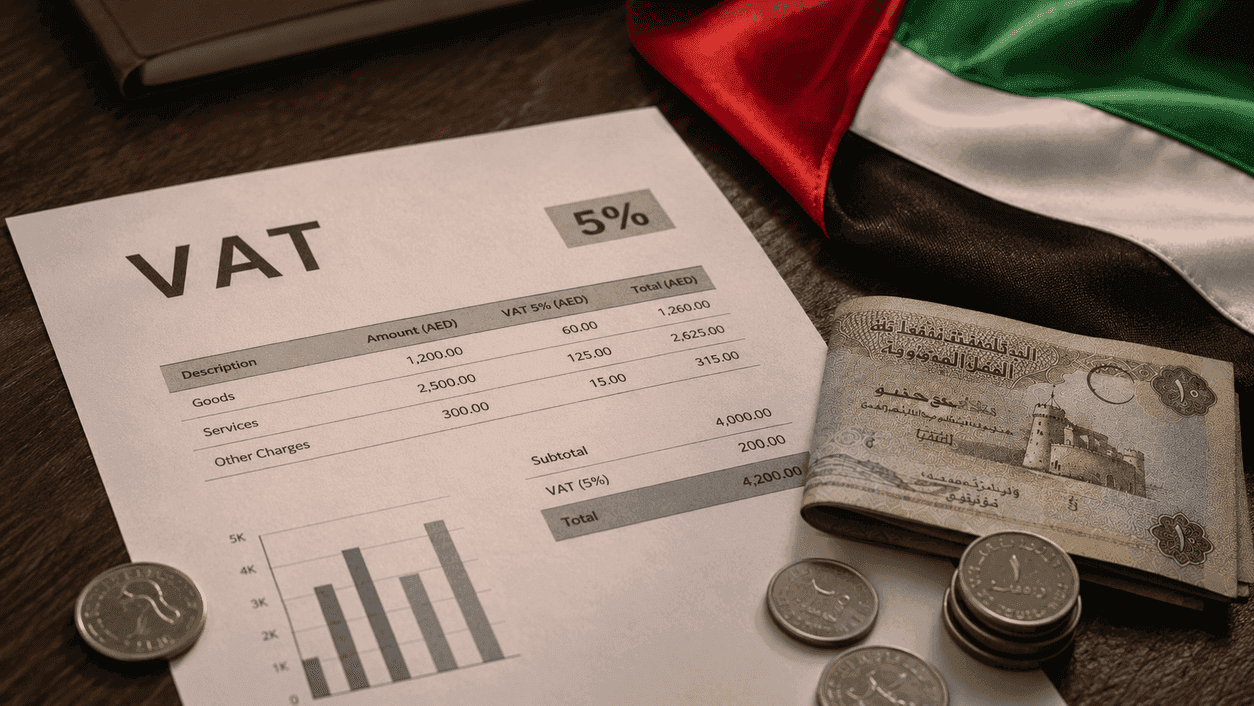
VAT isn't a tax on your business. It's a tax you collect from your customers on behalf of the government, and the cost of handling it wrong lands on you rather than on them.
The 5% Rate
VAT has applied across all seven emirates since 1 January 2018, at a standard rate of 5%.
The math is simpler than it sounds. You add 5% to what you charge your customers, which is your output VAT. You pay 5% on your own business purchases, which is your input VAT. You send the difference to the Federal Tax Authority.
A worked example. An agency invoices a Dubai client AED 10,000 and adds AED 500 of VAT. That quarter it also pays AED 200 of VAT on software subscriptions and professional fees. It remits AED 300 to the FTA and keeps the rest.
The agency never absorbed the 5%. Its client did. The agency's role was to collect it, record it correctly, and pass it on by the deadline.
But not every supply is charged at 5%. Some are charged at 0%, and some fall outside the VAT system entirely. Those two categories, zero-rated and exempt, look similar on an invoice and behave very differently underneath.
The Threshold Is on Revenue, Not Profit
Registration becomes mandatory once your taxable supplies and imports pass AED 375,000 over a rolling 12-month period, or once you expect to pass it within the next 30 days.
You may recognize that figure. It's the same number as the corporate tax threshold, and it measures something completely different.
The corporate tax threshold applies to profit. Revenue minus your deductible costs.
The VAT threshold applies to taxable supplies, which is close to what most people call turnover. What you invoiced, before a single expense is deducted.
The gap between the two is large enough to change your obligations entirely. A consultancy billing AED 600,000 with AED 300,000 of costs sits below the corporate tax threshold on AED 300,000 of profit, and well above the VAT threshold on AED 600,000 of supplies.
There's also a voluntary threshold of AED 187,500, which you can meet through your supplies, your imports, or your taxable expenses. Registering early is worth considering if you're spending heavily before revenue arrives, since input VAT on equipment, fit-out and professional fees can only be recovered once you're registered.
Registration Is on a 30-Day Clock
Once you cross the mandatory threshold, you have 30 days to submit your application. Missing that window carries an AED 10,000 penalty, along with liability for the VAT you should have been charging since the day you crossed.
Registration runs through the FTA's EmaraTax portal and typically takes several business days once your documents are complete.
Free zone companies register on the same terms as everyone else. A free zone license changes nothing about VAT registration, which catches people who have read about the free zone corporate tax treatment and assumed the two systems work alike.
Not Everything Is 5%: Zero-Rated and Exempt Supplies
A quick clarification before going further.
A "supply" in VAT law is a sale, not a purchase. So zero-rated and exempt describe types of sales, not types of expenses.
Zero-rated supplies are taxable supplies charged at 0%. They count toward your registration threshold, they appear on your return, and the input VAT on your related costs stays recoverable.
Exempt supplies sit outside the VAT system. No VAT is charged, and the input VAT on related costs cannot be recovered at all. Certain financial services, bare land, local passenger transport and residential property fall here.
The practical difference: a zero-rated business charges nothing and can still reclaim what it spent, while an exempt business charges nothing and absorbs the VAT on its own costs.
Exports of services to clients outside the UAE, when the conditions are met, are zero-rated. Which means charging 0% to your foreign clients does not take you out of the system. It puts you inside it at a rate of zero.
Zero-rated supplies still count toward the AED 375,000 threshold. A consultant billing AED 500,000 entirely to clients in Europe has crossed the mandatory threshold and has to register, even though every invoice carries 0% VAT.
Businesses making only zero-rated supplies can apply to the FTA for an exception from mandatory registration. It's an application, not a right, and the FTA assesses each one individually.
When Your Foreign Invoices Actually Qualify for 0%
Do you charge VAT to a client in Berlin? Usually not.
Zero-rating an exported service is conditional, and the burden of proving it sits with you rather than with the FTA. The conditions generally require that:
your client has no place of residence or fixed establishment in the UAE connected to the supply,
your client is outside the UAE when the service is performed,
the service isn't connected to real estate or goods located in the UAE,
and the service isn't consumed inside the UAE.
A Dubai marketing agency advising a UK company on a UK campaign is clearly working outside the UAE. The same agency advising that UK company on entering the Dubai market is not, and the treatment can change even though the client's address didn't.
Applying 0% because a client happens to have a foreign address isn't enough. You need to prove it.
Filing and Deadlines
Your VAT return is due within 28 days of the end of your tax period, and the payment shares that deadline. Most businesses file quarterly, with monthly filing assigned to larger ones.
Filing is required whether or not you owe anything. A quarter with no transactions still needs a return.
The penalties as they currently stand:
AED 1,000 for a first late filing, and AED 2,000 for a repeat within 24 months,
and late payment interest running at 14% per annum on the outstanding balance.
That interest structure took effect in April 2026, replacing a harsher compounding system, so anything you read describing daily percentage penalties is out of date.
Records need to be kept for five years, and considerably longer for real estate.
Which Situation Are You In
Most of this resolves once you know two things: your annual turnover, and where your clients are established.
If you bill under AED 187,500 and work with clients abroad, you're below both thresholds and registration is optional. Worth revisiting the moment your pipeline suggests you'll cross AED 375,000 in the coming year, since the clock starts the day you do.
If you bill above AED 375,000 to clients outside the UAE, registration is mandatory even though your invoices carry 0%. Your work is making sure your zero-rating actually holds up, and keeping the evidence that proves it.
If you have UAE clients in the mix, you're charging 5% on those invoices and recovering input VAT on your costs. This is the standard position, and the administration is more routine than founders expect once the accounting is set up properly.
If you're spending ahead of your revenue, voluntary registration at AED 187,500 may be worth it purely to recover the VAT on your setup costs.
Common Mistakes
Assuming foreign clients mean no VAT obligations
Zero-rated is inside the system. It counts toward your threshold and it appears on your returns.
Treating the AED 375,000 figures as interchangeable
One measures profit and one measures turnover. Using the wrong one produces a badly wrong answer about whether you need to register.
Zero-rating on the strength of a foreign address
The test looks at where the service is used, not only where the client is based. The evidence has to exist before anyone asks for it.
Missing the 30-day registration window
The AED 10,000 penalty comes with backdated liability for VAT you never charged and now have to fund yourself.
Skipping a return because the quarter was quiet
A nil return is still a return, and the AED 1,000 penalty applies the same way.
Final Thoughts
VAT rarely costs a well-run business much money. At 5%, with input VAT recoverable and most international revenue zero-rated, the tax itself is one of the lighter burdens in the UAE.
What it costs is attention. Deadlines every quarter, evidence that has to be gathered as you go, and a registration obligation that arrives on a 30-day clock rather than at year end.
If any of this feels like more than you want to manage alone, this is the sort of thing Monola takes care of for entrepreneurs, so accounting, tax and compliance stay in order rather than becoming a surprise later.
FAQ
What is the VAT rate in the UAE?
5% on most goods and services, applied across all seven emirates since January 2018. Certain supplies are zero-rated or exempt.
When does VAT registration become mandatory?
Once your taxable supplies and imports exceed AED 375,000 over a rolling 12-month period, or when you expect to exceed it within the next 30 days. You then have 30 days to apply.
Do I need to register for VAT if all my clients are outside the UAE?
Usually yes. Exported services are zero-rated rather than outside the system, so they still count toward the AED 375,000 threshold even though you charge 0%.
What is the difference between zero-rated and exempt?
Zero-rated supplies are taxed at 0% and allow you to recover input VAT on related costs. Exempt supplies fall outside the VAT system entirely, and the input VAT on their costs cannot be recovered.
Do free zone companies pay VAT in the UAE?
Yes. Free zone companies are subject to the same VAT registration and filing rules as mainland companies, though special rules apply to goods moving through Designated Zones.
When are VAT returns due?
Within 28 days of the end of each tax period, with the payment due on the same date. Most businesses file quarterly.
" height="27.109775px" id="SKxZ1GD3w" transform="translate(2.742 6.459)" width="35.01537499999998px"/></g></svg>)